The answer is somewhere.
People lose time searching emails, documents, chats, and tools. Important knowledge never makes it into the official system.
Make useful knowledge easier to find.KNOW WHAT YOUR ORGANIZATION KNOWS.
Important information is scattered across conversations, documents, people, and systems. We connect the context so you can find answers, see what matters, and decide what to do next.
Start with a free tool or a real business problem. No technical brief required.
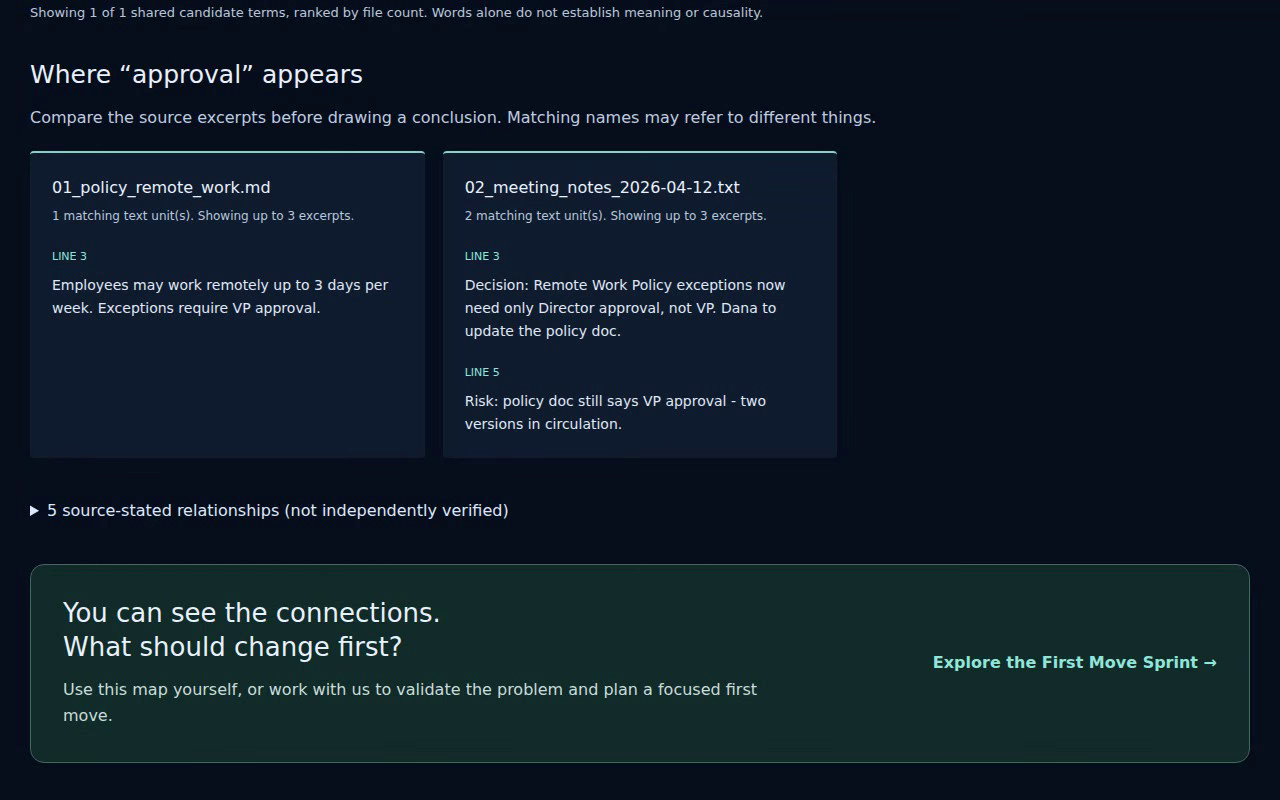
Still image shown for reduced motion.
The recording loads a policy, meeting notes, and a relationship table, then focuses on approval.
Policy: “Employees may work remotely up to 3 days per week. Exceptions require VP approval.”
Meeting note: “Decision: Remote Work Policy exceptions now need only Director approval, not VP. Dana to update the policy doc.”
These are fictional source statements for a person to compare, not a determination of which statement is authoritative.
OUR PURPOSE
Not another place to put information. A way to understand how the information you already have fits together.
FAMILIAR PROBLEMS. CONNECTED SOLUTIONS.
A small business, a public agency, or a global enterprise can run into the same questions.
People lose time searching emails, documents, chats, and tools. Important knowledge never makes it into the official system.
Make useful knowledge easier to find.Two documents say different things. A meeting changed the decision, but the record never caught up.
Keep answers tied to sources and owners.Work crosses teams. The right person, dependency, or approval is not obvious until something stops moving.
Make responsibility and handoffs visible.Leaders and AI tools see pieces of the picture. The relationships, exceptions, and reasons behind decisions are absent.
Bring the context into the decision.KNOWLEDGE GRAPHS, IN PLAIN ENGLISH
A knowledge graph connects people, policies, projects, systems, and decisions, along with the relationships between them and the sources behind them.
Instead of only finding a document, you can ask: What does this affect? Who is responsible? Where did that answer come from?
Explore the technical approach →The value is not a prettier diagram. It is understanding what needs to happen next.
THE KNOWLEDGE BETWEEN YOUR TOOLS
We begin by identifying the sources you use, the knowledge that is missing, and who has permission to see it.
Email, messaging tools, meeting transcripts, and the decisions people remember.
SharePoint, Confluence, shared drives, policy files, spreadsheets, and org charts.
Azure, AWS, business applications, Jira, Trello, and the records behind your operations.
Examples of a consulting source landscape, not a list of built-in First Graph connections. The free tool reads supported local files; live integrations require separately scoped implementation.
START SMALL. KEEP THE BIGGER PICTURE.
Bring together supported documents, notes, and spreadsheets. Find shared terms and inspect the source evidence.
Available now · Browser-local · No signup
Try First Graph →Formats and limitationsStart with one business problem. Understand what connects to it, validate the evidence, and agree what to change first.
First Move Sprint · Scoped consulting
Explore the sprint →Connect the right sources, establish ownership and permissions, and test a useful capability in your environment.
Implementation · Separately scoped support
Discuss your needs →EVIDENCE BEFORE EXPANSION
Define the outcome. Understand the relationships. Make a bounded move. Check the result and adapt.